Your bank account feels tight this month. Tighter than it should, honestly, given how busy things have been. So you pull up your P&L expecting bad news.
Instead, it says you made $8,000.
That’s the moment things get confusing. If you made $8,000, why does it feel like you’re scraping by? Which number is telling the truth?
Both of them, actually. They’re just answering two different questions — and almost every time I see this gap, the missing piece is loan payments.
Two different questions, two different answers
Your P&L answers: did the business earn more than it spent, on paper, this period? Loan principal payments don’t touch that number at all. When you pay down debt, you’re not incurring a new expense — you’re paying back money you already had access to and already benefited from. So your profit stays right where it was.
Your bank account answers a completely different question: how much actual cash moved in and out? Loan payments absolutely touch that number, every time, whether or not your P&L ever mentions them.
Here’s the comparison that usually makes it click: imagine you borrowed $10,000 from a friend to buy equipment, and you’re paying them back $500 a month. Your business didn’t get poorer the month you sent that $500 — you already had the equipment, already used it, already benefited from it. You’re just settling up on a debt you took on earlier. Your P&L doesn’t rewrite your past success just because you’re currently paying for it.
A quick way to bridge the gap
You don’t need your full Statement of Cash Flows to get a feel for this — that report is genuinely useful, but it’s built more for someone analyzing operating results line by line than for a fast gut-check. Most of the time, a back-of-napkin version gets you close enough, fast:
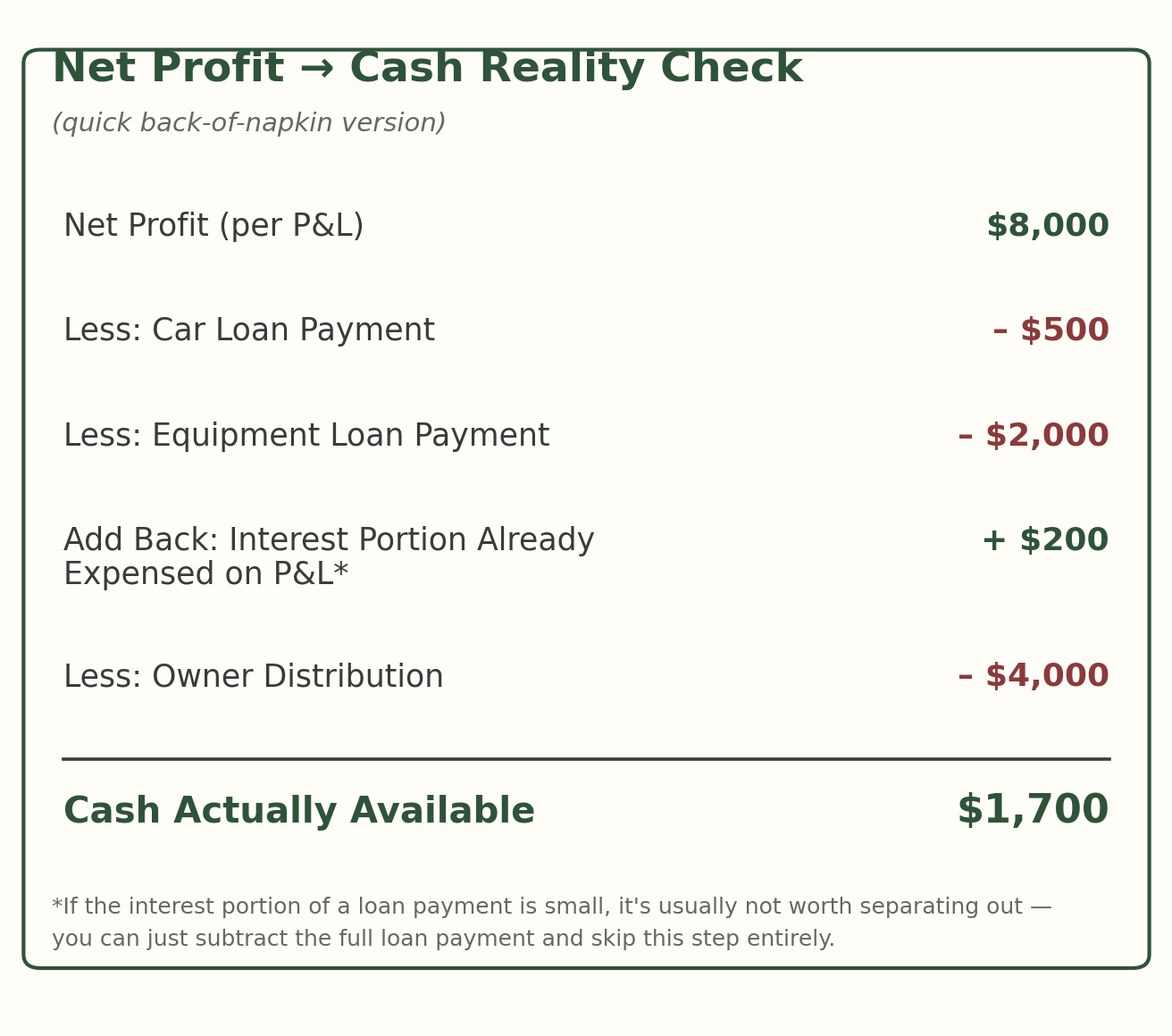
Start with net profit. Subtract the principal portion of any loan payments — car loans, equipment loans, anything with a fixed monthly payment. If you want to be precise, add back the interest portion of those payments, since interest is already sitting inside your P&L as an expense and subtracting the full payment would count it twice. In this example, that’s the $200 added back on the equipment loan.
Realistically, though, if the interest amount is small, most business owners just subtract the full loan payment and call it close enough. The goal here isn’t perfect accounting — it’s a fast, honest read on what you actually have to work with.
Where the disconnect actually shows up
This pattern shows up constantly with equipment loans, vehicle financing, and SBA loans — anything where a business borrowed money for something real, then spends years paying it back in fixed monthly installments.
The P&L shows healthy, growing profit. The bank account tells a tighter story. If you’re only looking at one of those two numbers, you’re only getting half the picture — sometimes the half that leads you to the wrong decision. I’ve seen business owners see a strong profit number and decide it’s time to hire, expand, or make a big purchase, without checking what their actual cash position supports. The P&L said yes. The bank account was quietly saying not yet.
Why this matters more than it seems
Once you know to check both numbers side by side, that tight-bank-account feeling stops being confusing and starts making sense. You’re not imagining it, and you’re not doing anything wrong. You’re just paying down something you already got the benefit from, and your P&L was never designed to show you that.
That distinction changes how you make decisions. You stop distrusting a good profit number just because your bank account doesn’t match it, and you stop making big moves off a number that was only ever telling you half the story.
If your bank account and your P&L have ever seemed to disagree with each other, this is almost always why. And if you’d like a clearer read on your own numbers, that’s a conversation I’m always happy to have.


Leave a Reply